The Body as Co-Creator

For a long time I operated under an assumption I didn't even know I was making: that I was in charge of my body. That my job was to manage it, direct it, optimize it — to be, in a sense, its boss. I made decisions about what it ate, how it moved, when it rested, what it was allowed to feel. And my body, bless it, kept trying to get a word in edgewise. Through fatigue, through cravings, through tension that wouldn't release no matter how many times I stretched it away. It had things to say. I just wasn't listening.

What shifted for me — and what I now invite my patients into — is the radical idea that the body is not a vehicle to be driven but a partner to be consulted. Every cell, every organ, every channel and fiber and vessel is carrying intelligence. The body knows what it needs to thrive. It knows what movement wants to happen, what food will genuinely nourish it, what it is in the process of becoming. When we stop overriding that intelligence and start collaborating with it, something remarkable happens. The body stops fighting us. It starts working with us — because we finally started working with it.

In my practice this shows up in many ways. Sometimes it's as simple as asking a patient to place their hand on the area that hurts and just listen — not to fix, not to analyze, just to be present with what's there. Sometimes it's deeper work, inviting the whole system — bones, fascia, organs, energy channels, all of it — to wake up together and show us what it needs. The body is not a problem to be solved. It is a co-creator. And the moment we treat it that way, healing stops being something we do to ourselves and becomes something we do together.


Learning to Trust the Unknown

There is a paradox at the heart of healing that I keep returning to: the deeper the trust, the less we need to know. This sounds counterintuitive in a world that rewards certainty, preparation, and having all the answers. We are trained from childhood to seek information, to solve, to understand. And yet some of the most profound shifts I have witnessed — in my patients and in myself — happen not when everything becomes clear, but when someone finally stops gripping the need for clarity and simply... rests in the not knowing.

I felt this once as a physical sensation — like a puzzle in my chest, shaped like an X. The not knowing itself had a geometry, a weight, a presence. And sitting with it rather than rushing to resolve it opened something. Trust is not the same as certainty. Trust is what you practice when certainty is unavailable. It is choosing to move forward anyway, to stay present anyway, to believe in the process even when — especially when — you cannot see where it leads.

In my practice, I see this show up constantly. Patients who need to understand exactly how acupuncture works before they can relax on the table. People who want a guarantee before they commit to a healing path. And I understand it — the mind wants a map. But healing often happens in the territory beyond the map. The body knows things the mind hasn't caught up to yet. The soul has been navigating long before the rational self arrived. Learning to trust the unknown is not passive. It is one of the most active, courageous things a person can do. And it is, in my experience, where the real work begins.

What Are You Dreaming? The Art of Active Creation

Most of us think of dreaming as something that happens to us — a nightly movie we didn't choose, playing out while we sleep. But what if dreaming is something far more active than that? What if it's one of the most powerful creative tools we have, available to us not just at night but in every quiet moment when we dare to ask: what's over there?

Robert Moss, one of the great modern teachers of dreaming, talks about dreams not as unconscious noise but as a living landscape we can navigate with intention and curiosity. I think of it similarly — as a kind of exploration. The dreamer moves forward with questions, and the territory reveals itself in response. What's over there? And what's over there? The land, in a sense, creates itself as you walk toward it. You are not just receiving the dream. You are co-creating it.

This is exactly how healing works too. When patients come to me, the ones who move most deeply aren't necessarily the ones with the clearest diagnosis — they're the ones willing to get curious. Willing to ask better questions. Willing to slow down enough to notice what's actually coming through. Dreams, visions, gut feelings, synchronicities — these are all data. The body is always speaking. The deeper self is always transmitting. The question is whether we've trained ourselves to receive.

So here's an invitation: start paying attention to what you're dreaming — asleep or awake. Write it down. Don't analyze it immediately. Just collect it. Notice what images keep returning, what feelings linger after you wake, what questions arise unbidden in the quiet moments before sleep. These are not random. They are dispatches from a part of you that knows more than your waking mind does. And if you'd like support learning to listen — that's exactly the kind of work we do together.

Soul Work

Soul Work: Turning Inward for the Answers You Already Carry

Pain is often the first reason we seek help. Pain from traumas, injuries, surgeries. Or the pain may be of an inner nature — stress, anxiety, depression, headaches, neck and back tension, or a feeling of being stuck. Imbalances in our hormones, our cycles, our capacity to move, breathe, or digest properly may wake us up to transitions happening beneath the surface. Sometimes it is the big changes in our lives — in our external environment — that turn our bodies and minds upside down and inside out, and we seek help to reorient, realign, re-attune. We want to heal. We want to remember what it feels like to be at home in our bodies.

But sometimes the ache goes deeper than the body. Sometimes what's calling for attention is the soul.

Soul work is the practice of turning inward for answers — and trusting that they're already there. In my practice, this can take many forms. It might look like a shamanic session to retrieve a part of yourself that got left behind during a trauma or a major life transition. It might be an Esoteric Acupuncture treatment that works with the Heart Shen — your spirit — to clear old patterns and reawaken your connection to your own knowing. It might simply be deep, unhurried listening while you find the words for something you've never been able to say out loud. Whatever form it takes, the through-line is the same: You are encoded with everything you need. Sometimes you just need a skilled witness to help you remember.

If you're in Louisville, Boulder, or anywhere along Colorado's Front Range and you're feeling the pull toward something deeper, I'd love to connect. Start with a free 15-minute phone consultation and let's feel out whether this work is right for you right now.

Acupuncture for Psychedelic Integration in Colorado

More and more people in Colorado are exploring plant medicine — psilocybin, ayahuasca, peyote, and others — as a path toward healing, self-discovery, and expanded awareness. These experiences can be profound and life-changing, but they can also leave you feeling ungrounded, emotionally raw, or unsure how to make sense of what you encountered. Integration — the process of weaving the insights from your experience into your everyday life — is just as important as the ceremony itself. This is where acupuncture can help.

Acupuncture works by supporting the nervous system, calming the body, and helping energy move through channels that may have been stirred or opened during a plant medicine experience. After a ceremony, many people find that their system needs time and support to settle — to fully land back in the body. A session combining acupuncture with the 8 Extraordinary Channels can help anchor new insights and support the integration process at a physical, emotional, and energetic level. Think of it as giving your body a chance to catch up with everything your mind and spirit just experienced.

If you're in the Louisville, Boulder, or greater Front Range area and you're looking for skilled, non-judgmental support after a plant medicine experience, I'd love to talk. I offer a free 15-minute phone consultation so we can connect before you book, and together we can figure out what kind of support would be most helpful for you right now.

Distraction and Avoidance Causing Anxiety

We know anxiety can be caused by a multitude of factors, but one I notice in the office talking with patients is due to distraction and avoidance of the difficult tasks or work that needs to get done but there is no zest or inspiration to complete. I began to share a life hack that I found useful for myself and noticed that patients were responding positively as they tried it out for themselves.

During a Panchakarma retreat this summer at a friend’s home, I noticed hanging in the dining room area a white board outlining the schedule and events of the whole household, everything from what was for dinner and when it would be served to exercise routines and grocery lists. In a corner of one of the boards, I saw a star chart for the oldest child which listed chores and tasks for her to complete. I asked how it worked. The response was enthusiastic and glowing for how easily it had changed a difficult challenge for the family to a situation of ease. Before it had been impossible to get the child to pick up her toys or make her bed, but now it was no problem. The parents explained that the stars represented points and based on the number of points the child could negotiate what reward she wanted, everything from an hour of television to buying a favorite dessert or a new toy. I wondered, would that work for me?

A friend gifted me a beautiful glass whiteboard two days later (I love synchronicity and see it as a sign I’m moving in the right direction when it happens). I wrote down all the laborious tasks I had been avoiding for weeks, everything from office tasks, automobile fixes, to gardening chores. I watched as my task list rapidly dwindled down. I already knew what I would buy for myself if I completed 120 points, each star representing five points. And oh my, it was awesome to gift myself the reward for doing all the work I’d been avoiding.

I marvel at how well this system works for me. I pay no attention to all the reward cards and points businesses offer, but this! This works surprisingly well because the reward is exactly what I want. For me it’s about giving myself something that I can’t easily justify buying because I don’t need it or it serves no purpose other than I am delighted. I’ve always wanted to try that indoor skydiving experience so it’s going on my list of rewards. What would you put on your list?

Breathwork: Parasympathetic vs Sympathetic

Breathwork

Recommended for healing the sympathetic response (fight and flight) and turning on the parasympathetic (rest and repose). We heal our bodies when we are in parasympathetic response.

Wim Hof Method—the basics of the breathwork. 1) 40 breaths in and out through the nose. 2) Release the last breath, let it out gently. 3) Then hold the breath, hold without an intake of air for as long as you can. 4) Take a deep breath and hold for 15 seconds.

I recommend the Wim Hof Method app.

Breathing through the nose is a parasympathetic breath—when we suckled as babies to eat, relax, and/or fall asleep, we were breathing through our noses.

Breathing though the mouth is a sympathetic breathing response that happens when we are hyper-aroused; for example running from a predator, having an anxiety attack, panic attack, or asthma attack. Mouth breathwork is used in practices like Holotropic Breathing and other trauma releasing techniques.

Sauerkraut for a Healthy Gut

Homemade Sauerkraut

Homemade Sauerkraut

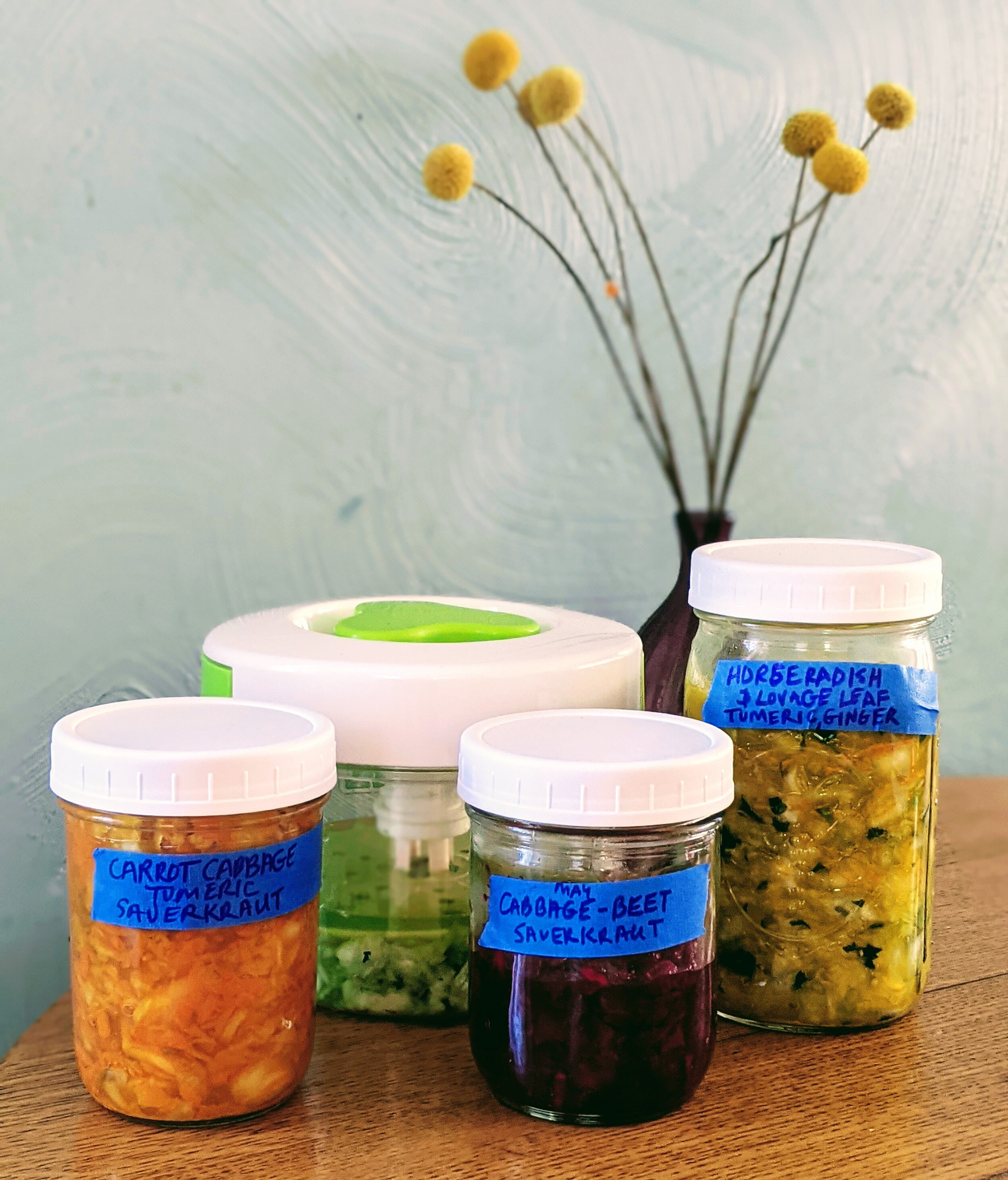
In the spring I begin making sauerkraut of all kinds, as this is the time of year when fermentation begins to pick up speed and roll on through the whole summer. Sauerkraut is a lacto-bacteria alchemical process whereby a little salt, some cabbage, and a deep massage create wonderful food for the gut. 

After years of being in the health-care industry, I am acutely aware that most people would benefit from creating an environment hospitable to healthy bacteria in their intestines rather than growing those pesky bacteria that cause pain and illness; think leaky gut syndrome and IBS.  

There is lots of wonderful information available for those who want the deep inside scoop. One of the sites dedicated to gut health that I recommend is Cultures for Health, however the focus and intent of this blog is to inspire an “I can do that!” feeling and an assurance that in twenty minutes you too can make your first sauerkraut.

Prep:

1 lb (about half of a medium sized) cabbage

1.5-2 tbs. salt per pound of cabbage

1 cabbage leaf

Pint mason jar

Large bowl

Weight

Method:

  1. Thinly slice cabbage and put in your bowl

  2. Add 1.5-2 tsp. salt 

  3. With clean hands mix, squeeze, massage the cabbage until your hands are tired. Wash your hands and go do something else for five minutes. Again wash your hands and mix, squeeze, massage the cabbage. Do this a few more times. You are helping the cabbage to release it’s fluids. Soon there will be quite a lot of briny water in the bottom of your bowl. I do this process anywhere between 15 - 20 minutes. The cabbage will be wet and pliable in your hands. 

  4. Pour the juice into the mason jar and then add the cabbage, packing the cabbage down with your fist as you go. You want the cabbage to be submerged under the salt water.

  5. Place a clean cabbage leaf over the top and add a weight such as a clean rock to keep the cabbage submerged under the water. Cover jar with a loosely fitted lid. (I don’t use a mason jar lid and ring as the lid can seal to the jar, making it impossible for gas exchange). Or if you don’t have a loosely fitting lid, you can improvise with a couple of layers of clean paper towels and a rubber band. 

  6. Leave the jar out on a clean surface for 4-7 days (longer if the weather is cold and the fermentation process is slow). By about day 4, sniff the jar to see how things are progressing and give it a taste (use a clean fork--you don’t want to introduce your bacteria into the batch). Usually by day 5 or 6 the ferment is done. But again, taste and see if it’s ready. It should be a little sour and smelling of sauerkraut. 

  7. Cover with a tight fitting lid and store in the refrigerator. 

Don’t worry if the sauerkraut bubbles white foam, it’s just the bacteria releasing gases. If you see any colored mold growing on top, gently remove it with a spoon. If the whole batch seems to be infected with mold or smells bad, toss it out. I’ve never had that happen, so if you have an issue, please feel free to reach out to me. 

Once you see how easy and wonderful it is to make your own sauerkraut, you’ll be wanting to experiment with different flavors. These are a few of my favorites.

Beets and cabbage sauerkraut

Carrot (or daikon), fresh ginger and turmeric sauerkraut

Lovage and horseradish leaf, garlic sauerkraut